


Trying to figure out whether Verizon actually has good coverage in your area? You’re not alone. Coverage is one of the top reasons people switch carriers—and one of the easiest things to misjudge if you only look at a national map.
This guide breaks down how Verizon’s coverage works, what the coverage map really shows, and how Verizon compares to other major carriers. We’ll also show you how to check coverage using Goji so you can make a decision based on where you actually use your phone.
How Verizon’s Network Works (4G LTE + 5G)
Verizon’s network is built on both 4G LTE and multiple types of 5G. Each plays a different role in real-world performance.
What you’ll see on the map:
- 4G LTE: Verizon’s most reliable and widely available network
- 5G Nationwide (low-band): Broader reach, similar speeds to LTE
- 5G Ultra Wideband (mid-band): Much faster speeds, limited availability
LTE still handles most calls, texts, and consistent data use. 5G Ultra Wideband is where Verizon delivers its fastest speeds, but it’s concentrated in select areas.
Verizon Coverage Map: What It Shows (and What It Doesn’t)
A coverage map shows where service is expected to be available—not guaranteed performance.
Important things to keep in mind:
- Maps don’t account for congestion or building materials
- Speed and reliability can vary block by block
- National views hide local differences
That’s why checking coverage at the ZIP code or address level matters. Using Goji’s coverage map lets you see Verizon’s coverage alongside other carriers in the same location, which is far more useful than looking at one map alone.
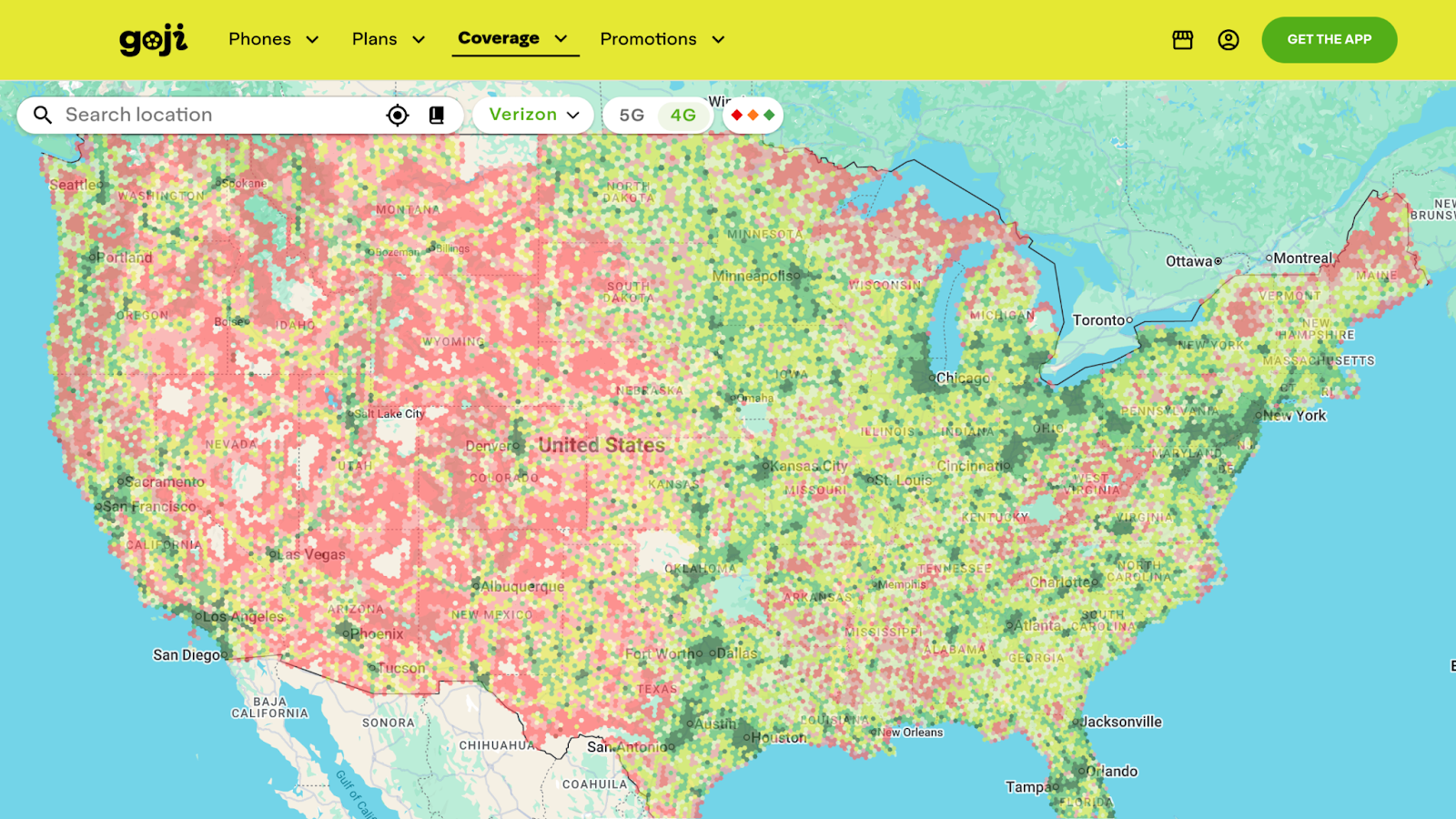
Verizon 4G LTE Coverage
Even with 5G expansion, LTE is still the backbone of Verizon’s network.
Why Verizon LTE stands out:
- Strong nationwide footprint
- Historically reliable in suburban and rural areas
- Consistent performance for everyday use
For many users, LTE is what keeps their phone working when 5G isn’t available or doesn’t offer a meaningful upgrade.
Verizon 5G Coverage
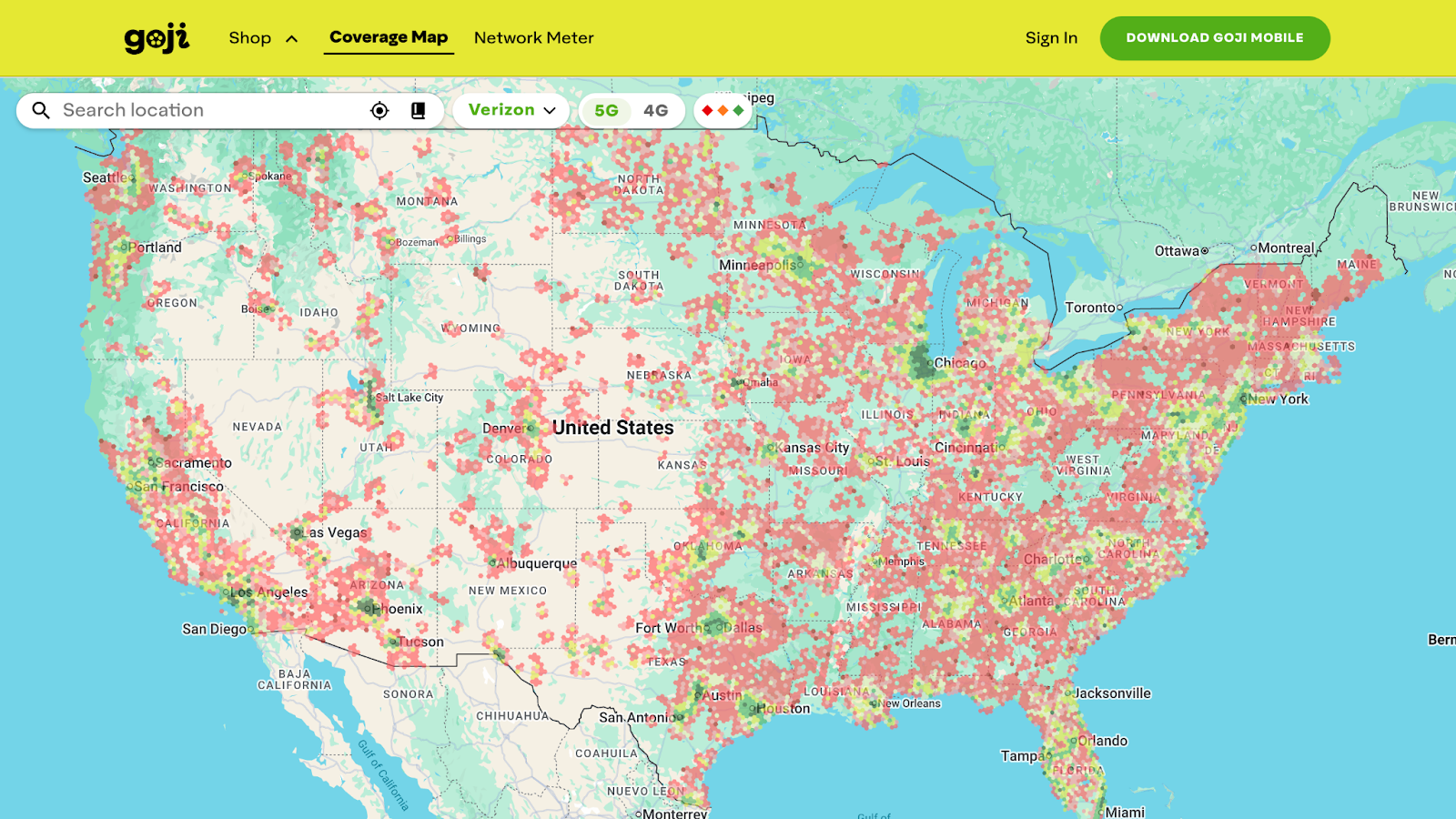
Verizon’s 5G coverage depends heavily on location and device compatibility.
Two types of Verizon 5G:
- 5G Nationwide: Wide coverage, modest speed improvements
- 5G Ultra Wideband: Very fast speeds, limited to certain areas
5G Ultra Wideband is most noticeable for:
- Streaming video
- Hotspot usage
- Gaming
- Remote work
Your phone must support Verizon’s 5G bands to access these speeds, even in covered areas.
Verizon Coverage by Region
Coverage can feel very different depending on where you live.
Urban areas
- Strong signal strength
- Dense 5G Ultra Wideband coverage
- Competitive speeds vs AT&T and T-Mobile
Suburban areas
- Mix of LTE and 5G Nationwide
- Growing Ultra Wideband pockets
- Reliable for families and daily use
Rural areas
- One of Verizon’s strongest regions
- Broad LTE availability
- 5G expanding more slowly but improving
Verizon Coverage vs. Other Carriers
Coverage is easier to understand when you compare carriers directly.
Verizon vs. AT&T
- Strong LTE coverage on both networks
- AT&T has improved mid-band 5G availability
- Performance varies by region
Read the full Verizon vs. AT&T comparison.
Verizon vs. T-Mobile
- T-Mobile leads in mid-band 5G reach, especially in cities
- Verizon remains strong in rural and remote areas
- Speed vs coverage is the key tradeoff
See the Verizon vs. T-Mobile breakdown.
Verizon Coverage vs. MVNOs on Verizon’s Network
Many prepaid and budget carriers use Verizon’s network, but performance can differ.
Key differences to know:
- Coverage maps may look similar
- Data can be deprioritized during congestion
- Speeds may slow at peak times
See the Verizon vs. Visible breakdown.
See the Verizon vs. Xfinity breakdown.
How to Check Verizon Coverage in Your Area
For the most accurate results:
- Check coverage by ZIP code or exact address
- Consider where you use your phone most
- Confirm your phone supports Verizon’s LTE and 5G bands
Goji’s coverage map helps you compare Verizon with other carriers in the same location so you can test before committing.
Check Verizon’s coverage at your address.
Plans That Work Best With Verizon Coverage
Verizon coverage is especially valuable for:
- Heavy data users
- Hotspot users
- Remote workers
- Families with multiple lines
In these cases, reliable coverage can have a bigger impact than headline speeds.
Final Thoughts: Is Verizon Coverage Good?
Verizon continues to offer strong nationwide LTE coverage, reliable rural performance, and expanding mid-band 5G in high-demand areas.
The best way to decide is simple: check coverage where you live and match it to how you use your phone. Check Verizon’s coverage at your address.
Frequently Asked Questions
How accurate is the Verizon coverage map?
It’s an estimate. Real-world performance depends on congestion, buildings, and terrain.
Is Verizon coverage better in rural areas?
Yes. Verizon has historically been one of the strongest carriers for rural LTE coverage.
Does Verizon have the best 5G coverage?
Not everywhere. T-Mobile leads in mid-band reach, while Verizon excels in speed where Ultra Wideband is available.
Does Verizon have roaming areas?
Yes, though most of the U.S. is covered by Verizon’s native network.
What MVNOs use Verizon’s network?
Visible, Xfinity Mobile, US Mobile, and others.
Does Verizon work well indoors?
Generally yes, though building materials and congestion can affect signal.
How do I check Verizon coverage in my ZIP code?
Use Goji’s coverage map to check Verizon and compare carriers side by side.
Is Verizon good for travel?
Yes, especially for domestic travel in suburban and rural areas.