


Choosing a mobile carrier is a big decision—after all, your phone is basically your lifeline. If you’re stuck between AT&T and Verizon, you’re not alone. These two powerhouses dominate the industry, but which one is actually better for coverage, speed, and reliability?
We’re breaking it all down for you—just the facts.
AT&T vs. Verizon: Quick Comparison
If you just want the fast facts, here’s the simplest breakdown of how AT&T and Verizon compare on price, performance, and perks. Consider this your one-scroll cheat sheet before we dig into the fuller details below.
Plans & Pricing Comparison
AT&T and Verizon are surprisingly close in price, especially once you start comparing similar plan tiers. The biggest differences usually show up in how much premium data you get, how much hotspot data is included, and which perks come bundled in. Here’s how their most popular plans stack up.
Unlimited Plans
If you’re a heavy data user or just don’t want to think about limits, both AT&T and Verizon offer strong unlimited options. Verizon usually leads with more premium data, while AT&T comes in a little cheaper for similar features.
- Price: $76/month for a single line.
- Data: Unlimited data with 75GB of premium data before potential slowdowns during congestion.
- Hotspot: 30GB of high-speed mobile hotspot data.
- International: Unlimited talk, text, and data in Mexico and Canada.

- Price: $80/month for a single line.
- Data: Unlimited premium data without deprioritization.
- Hotspot: 30GB of high-speed mobile hotspot data.
- International: Unlimited talk, text, and data in Mexico and Canada.
.png)
Family Plans
For families (or friend groups sharing a bill), both carriers offer major savings when you add multiple lines. AT&T and Verizon sit almost neck-and-neck here, with only slight differences in monthly pricing.
AT&T Unlimited Extra (4 Lines)
- Price: $41/month per line for 4 lines.
- Features: Includes all benefits of the Unlimited Extra plan above.
Verizon Unlimited Plus (4 Lines)
- Price: $45/month per line for 4 lines.
- Features: Includes all benefits of the Unlimited Plus plan above.
Prepaid Plans
Looking for something flexible with no long-term commitments? AT&T and Verizon both have prepaid unlimited options that keep things simple. Prepaid plans usually cost less than postpaid, but you’ll still want to compare hotspot allowances and international features.
- Price: $65/month per line.
- Data: Unlimited data (may be slowed during congestion).
- Hotspot: 25GB of high-speed mobile hotspot data.
- International: Unlimited talk and text to Mexico and Canada.

- Price: $50/month per line with AutoPay discount.
- Data: Unlimited data (may be slowed during congestion).
- Hotspot: 5GB high-speed mobile hotspot data.
- International: Roaming in 4 countries.
.png)
Travel Plans
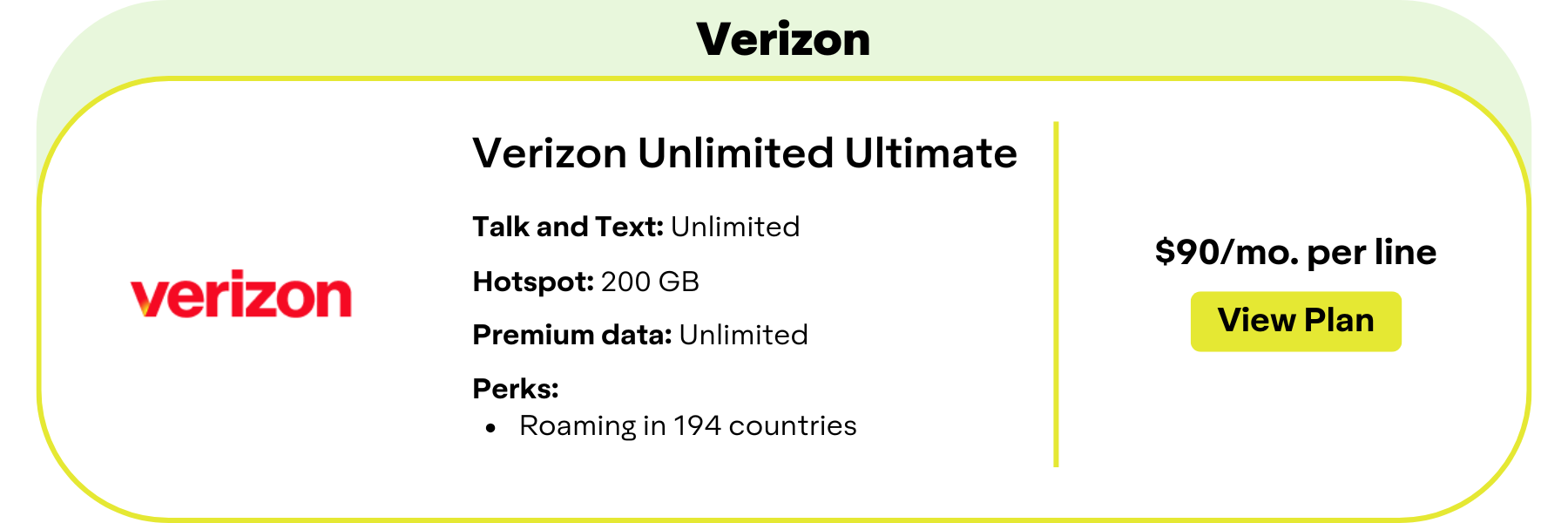
If you travel often—especially internationally—these are the plans to look at. Both carriers offer premium data, big hotspot buckets, and roaming perks, but Verizon’s global coverage pulls ahead while AT&T delivers more value in specific regions.
- Price: $86/month for a single line.
- Data: Unlimited premium data without deprioritization.
- Hotspot: 60GB of high-speed mobile hotspot data.
- International: Roaming in 21 countries.

- Price: $90/month for a single line with AutoPay.
- Data: Unlimited premium data without deprioritization.
- Hotspot: 200GB of high-speed mobile hotspot data.
- International: Roaming in 294 countries
Coverage Comparison
Coverage is one of the biggest factors when choosing between AT&T and Verizon. While both carriers have strong nationwide networks, there are key differences in where each one excels.
- Verizon: Claims to cover 99% of the U.S. population with its 4G LTE network, making it one of the most expansive networks available.
- AT&T: Covers around 68% of the land area in the U.S. with 4G LTE, but has a wider 5G footprint, offering 5G coverage in more places than Verizon.
- 5G Differences:
- AT&T has broader 5G coverage, particularly with its low-band and mid-band 5G networks.
- Verizon’s 5G Ultra Wideband network provides faster speeds in certain cities, but it’s not as widespread as AT&T’s standard 5G.
Curious to see what AT&T’s 5G Map looks like? Here’s a snapshot:

📍 Want to know what AT&T’s coverage looks like in your area? Check here.
Curious to see what Verizon’s 5G Map looks like? Here’s a snapshot:

📍 Want to know what Verizon’s coverage looks like in your area? Check here.
🏆 Coverage Winner: AT&T for 5G, Verizon for 4G LTE
- If you want the broadest 5G availability, AT&T wins.
- If you rely on 4G LTE for consistent coverage, Verizon is still the strongest nationwide.
Network Speeds & Performance
When it comes to day-to-day performance, AT&T and Verizon each shine in different ways. AT&T leads with wider 5G availability and growing speeds, while Verizon still dominates in consistency and overall reliability. Here’s how both networks compare when you’re actually using them in the real world.
5G Network Performance
Both carriers offer fast 5G, but they approach it differently.
AT&T’s 5G network brings big speed improvements over its 4G LTE coverage—especially in cities where its mid-band 5G is live. Verizon, on the other hand, stands out for ultra-reliable performance across 5G video streaming, gaming, and upload speeds.
🏆 Winner: Verizon for consistency, AT&T for wider 5G availability.
If you want the fastest 5G more often, go AT&T. If you want fewer hiccups during gaming or video, Verizon takes the lead.
Consistency and Reliability
This is where Verizon really pulls ahead. Third-party reports consistently highlight Verizon’s strong performance in categories like 5G video experience, live video reliability, upload speeds, and gaming stability. AT&T performs well overall but still lags slightly behind in consistency across regions.
🏆 Winner: Verizon
If reliability matters more than raw speed, Verizon is the safer bet.
Real-World Performance
Here’s how each network feels when you’re actually using your phone:
- Urban areas: AT&T’s broader 5G footprint gives it an advantage in many major cities, often delivering faster download speeds.
- Suburban & rural areas: Verizon’s huge 4G LTE network still provides the most dependable service, especially outside major metro areas.
🏆 Winner: AT&T in cities, Verizon in suburban and rural areas.
Performance depends on where you live—but these patterns hold true for most users.
Perks & Extras
Beyond coverage and speed, AT&T and Verizon offer extra perks to make their plans more appealing. These can include streaming subscriptions, hotspot data, international roaming, and discounts on additional lines or devices.
AT&T Perks
- Streaming Benefits: HBO Max is included with certain premium plans.
- Bundling Discounts: Save when you combine AT&T Internet, TV, or wireless plans.
- Hotspot Allowances: Higher-tier plans offer up to 60GB of mobile hotspot data.
- International Perks: Free talk, text, and data in Mexico and Canada; select plans also include 20 Latin American countries.
Verizon Perks
- Streaming Benefits: Select plans include Disney+, Hulu, and ESPN+.
- Apple Music & Cloud Storage: Some plans include Apple Music trials and Verizon Cloud storage.
- More Hotspot Data: Higher-tier plans offer up to 60GB of high-speed mobile hotspot data.
- International Perks: Free talk, text, and data in Mexico and Canada; some plans offer 10GB of high-speed data per month in over 210 countries.
🏆 Perks Winner: Verizon (Entertainment), AT&T (Home Bundles)
- Verizon wins for the most valuable streaming and entertainment perks.
- AT&T wins if you want bundle savings with home internet or TV.
Customer Support & Satisfaction
Customer service can make or break your experience with a carrier, especially when dealing with billing issues, device upgrades, or technical problems.
- Verizon: Generally ranked higher in customer satisfaction, with strong in-store, phone, and online support.
- AT&T: Has improved over the years but still receives mixed reviews, particularly regarding wait times and issue resolution.
- Support Channels: Both carriers offer phone, chat, and in-store support, but Verizon is often praised for quicker issue resolution.
🏆 Customer Support Winner: Verizon
If quick, reliable support is important to you, Verizon is the stronger choice.
Device Compatibility & Upgrades
Both AT&T and Verizon support a wide range of devices, including iPhones, Samsung Galaxy phones, and other top brands. However, there are key differences in upgrade options and compatibility.
- Bring Your Own Device (BYOD): Both carriers allow unlocked phones to be used, but compatibility depends on network bands.
- 5G Device Support: Verizon’s Ultra Wideband 5G network requires specific 5G-compatible phones to access the fastest speeds.
- Upgrade Programs:
- AT&T Next Up ($6/month) allows you to upgrade after paying off 50% of your phone.
- Verizon’s Upgrade Program offers early upgrades with trade-ins but generally requires paying off 50% or more of your current phone.
- Trade-In Deals: Verizon typically offers higher trade-in values, especially for flagship devices like iPhones and Samsung Galaxy phones.
🏆 Upgrade & Device Winner: Verizon (Trade-Ins), AT&T (Upgrade Flexibility)
- Verizon wins for the best trade-in values and incentives on new devices.
- AT&T wins if you want easier, lower-threshold upgrades through Next Up.
Pros & Cons Summary
Still undecided? Here’s a quick rundown of each carrier’s strengths and weaknesses.
AT&T
Pros
- Better 5G coverage across the U.S.
- More affordable unlimited plans compared to Verizon.
- HBO Max included on certain plans.
- Good bundling options if you have AT&T Internet or TV.
Cons
- 4G LTE coverage isn’t as strong as Verizon’s.
- Data speeds can be inconsistent depending on location.
- Customer service is hit or miss in some cases.
Verizon
Pros
- Industry-leading 4G LTE coverage, reaching 99% of the U.S. population.
- Fastest overall data speeds, particularly on 4G LTE.
- Premium perks like Disney+, Hulu, and Apple Music.
- Better trade-in and upgrade deals than AT&T.
Cons
- More expensive plans compared to AT&T.
- 5G coverage isn’t as widespread as AT&T’s.
- Lower-tier plans don’t include as many perks compared to premium options.
Who Should Choose Which?
Still torn between AT&T and Verizon? Here’s the simple version. Based on everything we covered—from pricing to performance to perks—here’s who each carrier is actually best for.
Choose AT&T if…
- You want the widest 5G coverage. AT&T reaches more people with 5G and has better mid-band availability in many cities.
- You want slightly cheaper unlimited prices. AT&T’s plans usually come in a bit lower than Verizon’s top-tier options.
- You’re already an AT&T home internet or TV customer. Bundles can save you real money.
- You care more about overall availability than max speeds. AT&T performs especially well in urban areas.
- You want HBO Max included. Select plans offer it as a built-in perk.
Choose Verizon if…
- You want the strongest overall reliability. Verizon leads in consistency for video, gaming, and upload performance.
- You live in suburban or rural areas. Verizon’s 4G LTE network reaches 99% of the U.S. population—still the gold standard.
- You want premium perks. Disney+, Hulu, ESPN+, Apple Music trials, and better trade-in deals make Verizon’s extras feel more valuable.
- You travel internationally. Verizon offers data in over 210 countries on its high-tier plans.
- You don’t want deprioritization. Many Verizon plans offer fully premium (always-priority) data.
FAQ
Is AT&T better than Verizon?
It depends! AT&T has better 5G coverage and cheaper plans, while Verizon has better 4G LTE coverage and faster speeds.
How do I switch carriers?
Make sure your phone is unlocked and compatible with the other carrier. Then, contact the carrier to transfer your number and activate a new plan.
Is AT&T cheaper than Verizon?
Yes, AT&T’s unlimited plans tend to be slightly cheaper, especially if you bundle with AT&T Internet or TV.
Can I use an AT&T phone on Verizon’s network?
If it’s unlocked and supports Verizon’s network bands, you should be able to switch. It’s always best to check before making the move.