


Wondering what network Consumer Cellular uses—and what that means for your coverage, speeds, and reliability? You’re in the right place. In this guide, we’ll break down which major network(s) Consumer Cellular runs on, how their setup works, and how to check coverage in your exact ZIP code (the only coverage that matters, honestly).
What Network Does Consumer Cellular Use?
Consumer Cellular is an MVNO (mobile virtual network operator) that uses major carrier networks—primarily AT&T, and (in some cases) T-Mobile.
What that means for you:
- Coverage quality: you’re generally getting “big carrier” coverage because the towers belong to the big carriers.
- Reliability & speeds: often solid—but MVNO customers can see deprioritization (slower data) when the network is busy.
- Which network you’re on matters a lot for rural vs. city performance.
Quick nuance: Many sources still describe Consumer Cellular as using AT&T + T-Mobile. But at least one major consumer resource notes that new customers may be placed on AT&T (with T-Mobile being more “legacy/limited”). Bottom line: assume AT&T is most common, and treat T-Mobile as “possible depending on your SIM/account.” (We’ll show you how to check.)
How Consumer Cellular’s Network Setup Works
Consumer Cellular is a classic MVNO: they don’t own cell towers—they lease access to one (or more) big networks. MVNOs do this to keep costs lower and offer simpler plans.
So how do they decide whether you’re on AT&T or T-Mobile?
It typically comes down to things like:
- Your SIM/eSIM provisioning (the network your SIM is tied to)
- Device compatibility (bands, VoLTE/5G support)
- Region + activation rules (some activations default one way)
- Legacy accounts vs. new activations
What the experience is like (the good + the “meh”)
- The good: you can get excellent nationwide coverage because it’s built on major networks.
- The “meh”: during congestion (think: concerts, airports, Friday night traffic), MVNO data can be deprioritized, meaning your speeds may dip compared to premium postpaid customers.
Consumer Cellular Coverage Maps
Consumer Cellular coverage depends on the underlying partner network your line is using. Consumer Cellular customers can get 4G LTE and 5G access via those partner networks (with a compatible device + in a 5G area).
AT&T Coverage Map
AT&T is known for a strong nationwide footprint and tends to perform well outside major cities (especially compared to some competitors), with generally consistent coverage across a lot of rural/suburban areas.
Many Consumer Cellular lines appear to be provisioned on AT&T, especially for newer activations.
What to do next (best move):
- Check AT&T coverage in your ZIP code using Goji’s coverage tools (because “nationwide coverage” doesn’t help if your street is a dead zone 🙃).
- Then compare it to T-Mobile below.
Here’s a screenshot of AT&T’s coverage map:

Check out what AT&T’s coverage map looks like at your location here.
T-Mobile Coverage Map
T-Mobile is famous for fast urban performance and very strong mid-band 5G in many areas—so if you live in a city (or close to one), T-Mobile can feel snappy.
Some Consumer Cellular customers may be placed on T-Mobile depending on their SIM/account setup (often described as less common for new activations, but still relevant).
T-Mobile may be better than AT&T when:
- You’re in a metro area with strong 5G coverage
- You care more about speed than deep rural reach
- Your local AT&T coverage is “bars-but-no-internet” (we’ve all been there)
Here’s a screenshot of T-Mobile’s coverage map:
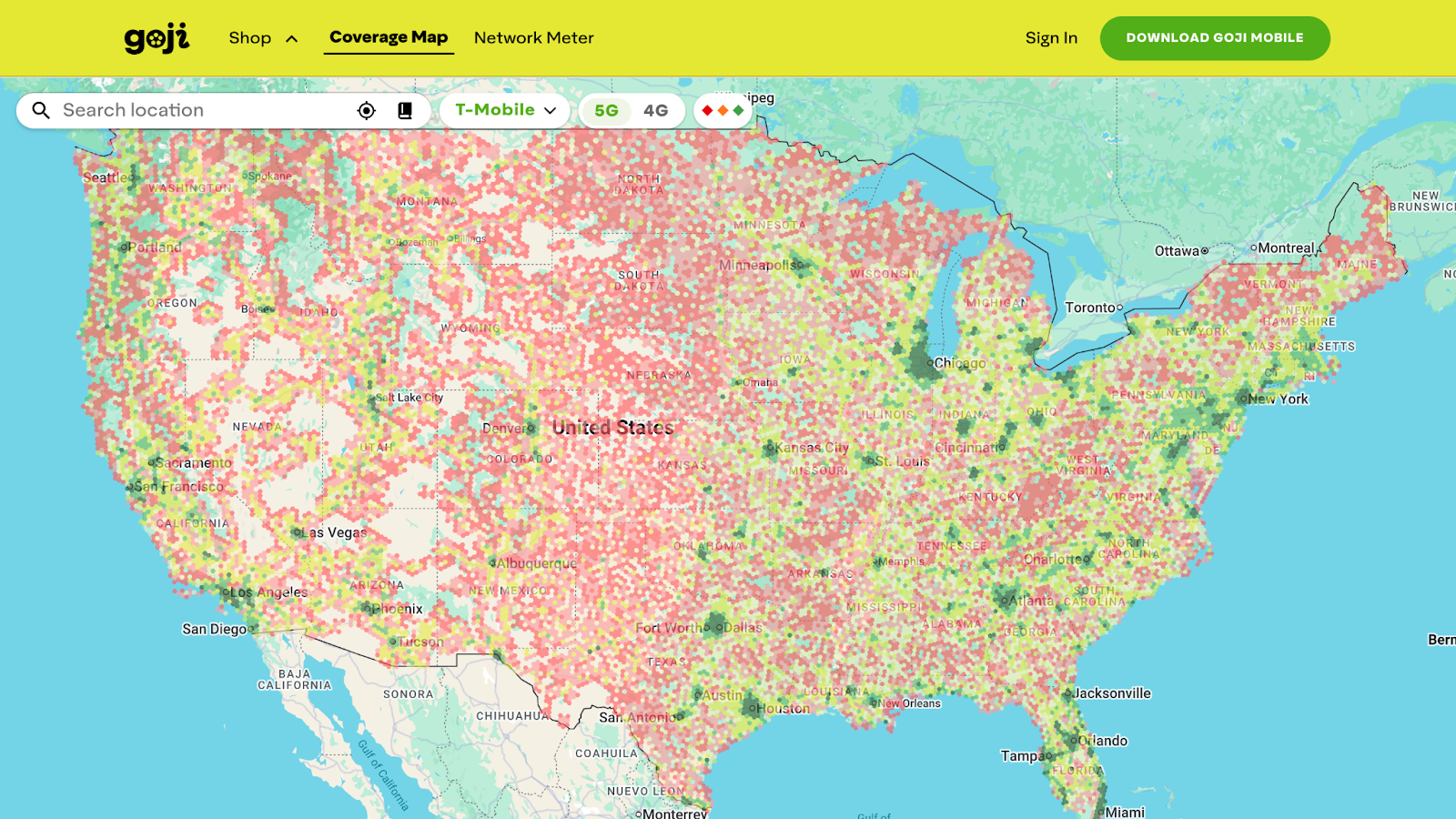
Check out what T-Mobile’s coverage map looks like at your location here.
Consumer Cellular vs. Other Popular MVNOs
Consumer Cellular lives in a very specific lane: simple plans, strong customer support, and senior-friendly perks (including AARP discounts).
Here’s how it stacks up against a few other big MVNO names—focused on the stuff people actually care about: network(s), price, who it’s best for, and how consistent coverage tends to feel.
Pricing and network setups can change with promos and provisioning rules—always double-check what’s available for your ZIP code and device before you commit.
Explore Consumer Cellular Plans With Goji
Consumer Cellular keeps things refreshingly simple. Expect:
- Unlimited talk & text across the board
- A few data tiers (great if you don’t need unlimited)
- An unlimited data option for heavier users
- No contracts, and plans that can flex as your needs change
- AARP perks (depending on the offer): special plan pricing, accessory discounts, and/or extended trial periods
Typical lineup looks like:
- Low data (great for light users / Wi-Fi folks)
- Mid-tier data (social, maps, music, normal-life stuff)
- Unlimited data (streaming, hotspots, heavy daily use)
Explore Consumer Cellular Plans With Goji
Let’s recap the big takeaways:
- Consumer Cellular runs on major networks—primarily AT&T, and sometimes T-Mobile depending on your SIM/account setup.
- Coverage can be strong, but your experience depends on which underlying network you’re on and how it performs in your area.
- The smartest move is to compare coverage by ZIP code and then match plans to your actual data habits.
Next step:
- Compare coverage in your area with Goji’s coverage map
- Then compare Consumer Cellular plans side-by-side so you can pick the best combo of price + coverage + perks
Frequently Asked Questions: Consumer Cellular Network
Does Consumer Cellular use AT&T or T-Mobile?
Consumer Cellular is commonly described as using AT&T and T-Mobile, but multiple sources indicate AT&T is the primary network for many customers, and some note new activations may be AT&T-only depending on current provisioning.
Does Consumer Cellular have its own network?
Nope. Consumer Cellular is an MVNO, meaning it doesn’t own cell towers—it leases access from major carrier networks.
Will I get 5G on Consumer Cellular?
In many areas, yes—Consumer Cellular customers can get 5G through the partner network(s), as long as you have a 5G-capable phone and you’re in a 5G coverage area.
Can I choose which network my Consumer Cellular phone uses?
Usually, you can’t just toggle a switch and hop networks. It’s typically determined by your SIM/eSIM provisioning and account setup. If you want to switch underlying networks, you’ll likely need to contact support and ask what options exist for your device/account.
How can I check which network I’m connected to?
A few easy ways:
- Look at your SIM card details in your phone settings (sometimes it hints at the carrier profile)
- Check your account/support docs
- Or do the foolproof method: ask Consumer Cellular support to confirm which underlying network your line is provisioned on
Does my phone need to be unlocked for Consumer Cellular?
If you’re bringing your own phone, unlocked is best. It increases compatibility and reduces activation headaches—especially if provisioning rules change or you’re moving between networks.
Is Consumer Cellular good for rural areas?
It can be—especially if your line is on a network with stronger rural reach (often AT&T). But rural coverage is hyper-local, so the right answer is: check your exact area using a ZIP-code coverage tool before switching.